Figuring out car parts names might seem tricky at first, but once you break it down into major systems, you’ll see how everything fits together. Plus, getting familiar with these parts helps you feel more in control, whether at the mechanic or just curious about how your car works. Here are the major systems of your car and their constituent parts.
Related:
- All About Wildlife: Jungle Animals List
- 100+ Fruit Names (Common, Exotic, Tropical, and More!)
- Different Types of Flowers
Brake System
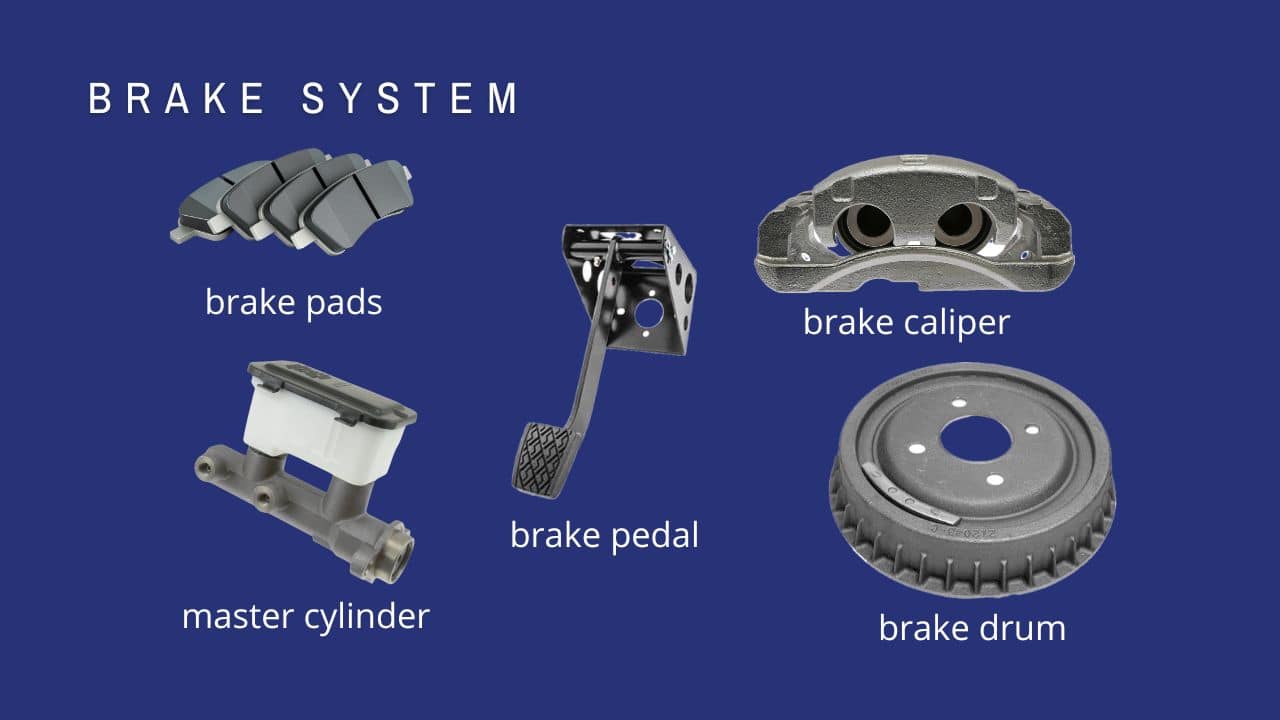
Stopping safely is not just about a pedal push; it involves several components working together within the brake system. This system is responsible for slowing or bringing your car to a complete stop. Some important parts of the brake system include:
Brake Pads
When you step on the brake pedal, the brake pads push onto the rotors. This contact creates friction, which will slow the wheel down, eventually stopping the car. If the brake pads wear down to the recommended minimum thickness of 3-4mm or if you hear a squealing noise when you brake, visit a car repair shop to have it replaced.
Brake Pedal
The braking process starts with your right foot pushing down the brake pedal, which controls your braking. When you apply light pressure on the brake pedals, it slows the car down, but if you press too hard, you could come to a sudden stop or cause the tires to skid.
Master Cylinder
When you brake, your foot compresses the pistons in the master cylinder, which converts your foot pressure into hydraulic pressure that helps activate the brakes. A master cylinder is often dual-chambered, which means that if one fails, the other can still function. If there is a brake fluid leak, you might have a master cylinder issue.
Brake Calipers
Calipers sit around the rotors like a clamp, helping you to compress brake pads against the brake disc. This squeezing action provides the required force to decelerate or stop the vehicle sufficiently.
Brake Drums
Brake drums are hollow cylindrical metals that house the brake shoes. When you brake, the brake shoes expand and press against the walls of the brake drums, creating friction that produces the braking force. Brake drums are usually a rear-wheel-based system that gives extra power for stopping and better stability to the vehicle.
Steering System
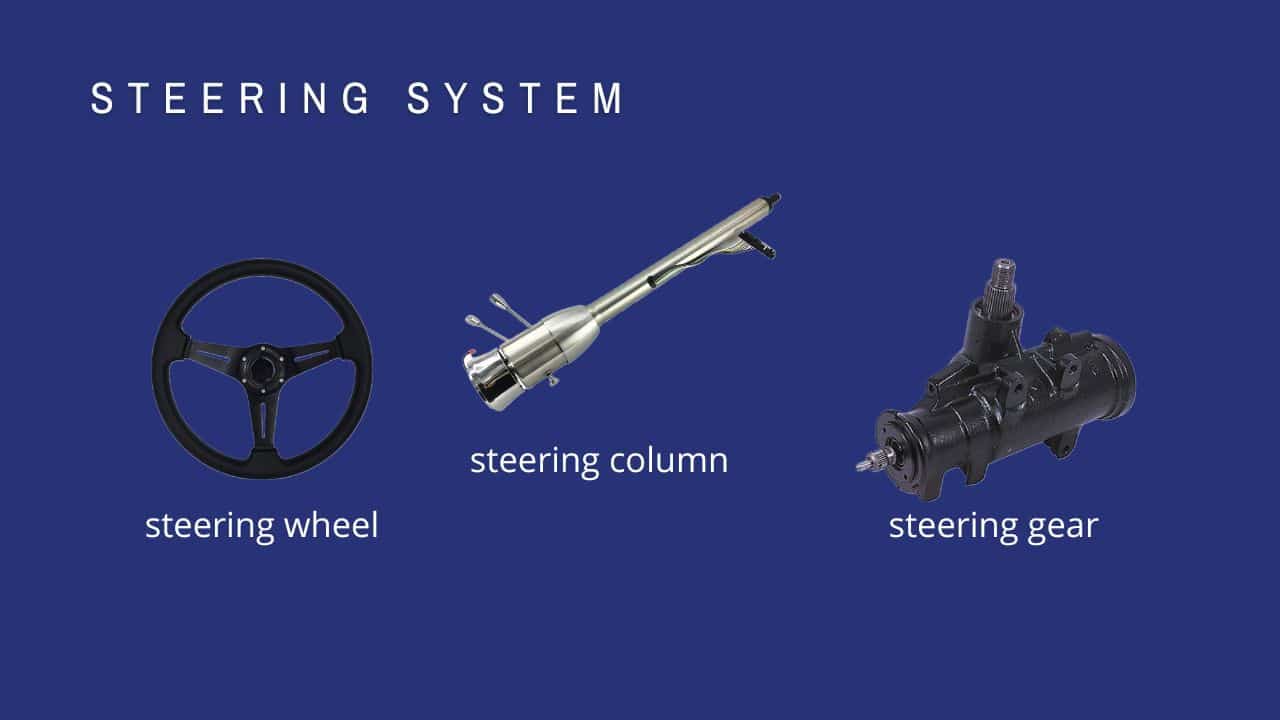
Wondering what car system is responsible for maneuvering? It’s the steering system. This intricate mechanism takes every subtle shift of your hands and accurately translates them into precise movements of your front wheels.
Steering Wheel
Your steering wheel is your main control center, as its movement determines the directional changes of the front wheels. For instance, if you turn it to the right, your car’s wheels also move to the right.
Steering Column
In some cars, you might notice a slightly visible shaft behind the steering wheel extending into the dashboard. This is the steering column that joins the steering wheel to the steering mechanism. Its main function is to transfer your steering wheel input to the steering gears, hence turning the car wheels.
Steering Gear (Steering Box/Rack and Pinion)
When you steer the steering wheel, the steering gears convert the rotary motion to lateral movement and transfer it to your car’s wheels. Most cars use the rack and pinion gears because they offer easy handling and precise control. I
Ignition System

The ignition system provides the power that wakes everything up. Without it, your car won’t start. Let’s break down its key parts:
Ignition Switch
Think of the ignition switch as an “on” button for your car. When you turn your key or press a button, the ignition switch sends power to the starter relay, which will start the engine. You can also use the ignition switch to activate electrical systems like your radio and lights.
Spark Plugs
Without them, your car will not start. These small components create sparks that ignite the air and fuel mixture in your engine. The resulting combustion pushes the pistons and generates mechanical power to keep your car moving. Essentially, spark plugs fire several thousand times per minute while driving, which keeps the engine going.
Engine Control Unit (ECU)
Theoretically, the ECU is the brain of a vehicle’s engine, ensuring everything works for optimal performance. It controls the timing of sparks, fuel delivery, and other activities within the combustion engine. It also controls other systems like transmission and emissions. If there are ECU problems, it can lead to poor fuel economy or engine stalling.
Starter Motor
Usually attached to the engine, the starter motor cranks your engine. Once you turn the ignition switch, the starter motor draws an electric current from the battery that spins the engine’s flywheel. The spin provides the necessary initial rotational energy for the engine to start combustion.
Engine System

The engine system is what gives your vehicle the power to move. Your car mixes fuel and air in the engine and converts it to energy through a series of well-coordinated processes.
Engine Block
You can think of the engine block as the engine’s heart because it carries vital components like cylinders, pistons, and crankshafts. Ideally, the engine block is made of cast iron or aluminum to endure extreme conditions.
Engine blocks can vary in design. Some cars have an inline, flat, or V engine block.
Cylinders
That said, this part sits within an engine block. The cylinders are chambers that consist of valves and a piston, where air and fuel mix and are consequently ignited to generate energy. More powerful engines typically have more cylinders.
Pistons
Inside the cylinders, you’ll find pistons that transfer the burning force in the combustion chamber to the crankshaft. As the fuel burns, this component moves up and down, transferring the created combustion force to the crankshaft.
Crankshaft
As pistons move up and down, the crankshaft receives these motions and turns their up-and-down movement into rotation, which allows your car to move forward. The crankshaft has several crankpins connecting it to the pistons that enable it to rotate.
The crankshaft also helps drive other components like the oil pump and alternator.
Exhaust System

Your car’s exhaust system contains a series of pipes and devices that filter harmful gases and convert them to less toxic substances before releasing them into the atmosphere. In addition, the exhaust system contains components that reduce annoying noise. Some main car parts names that make up the exhaust system include:
Exhaust Manifold
All the exhaust gases from the cylinders collect at the exhaust manifold. It acts as a funnel through which emissions are directed to the atmosphere. If your car has four-cylinder engines or less, it should have one manifold. However, vehicles with ‘vee’ arrangements like the V6, V8, etc. have two.
Exhaust Pipes
At the rear end of your car, you’ll notice a protruding metal tube called an exhaust pipe. The tube creates an exit route for the emissions coming from the exhaust system. Some exhaust pipes have catalytic converters to reduce harmful emissions.
Resonator
Some cars have a resonator that specifically tunes sound notes and removes high-pitched noises and buzzes. A resonator is often used in combination with the muffler to achieve a certain sound.
Muffler
You can find the muffler at the bottom rear of your car. Generally, mufflers work by reducing the speed of exhaust gases as well as absorbing and canceling sound waves.
Suspension System
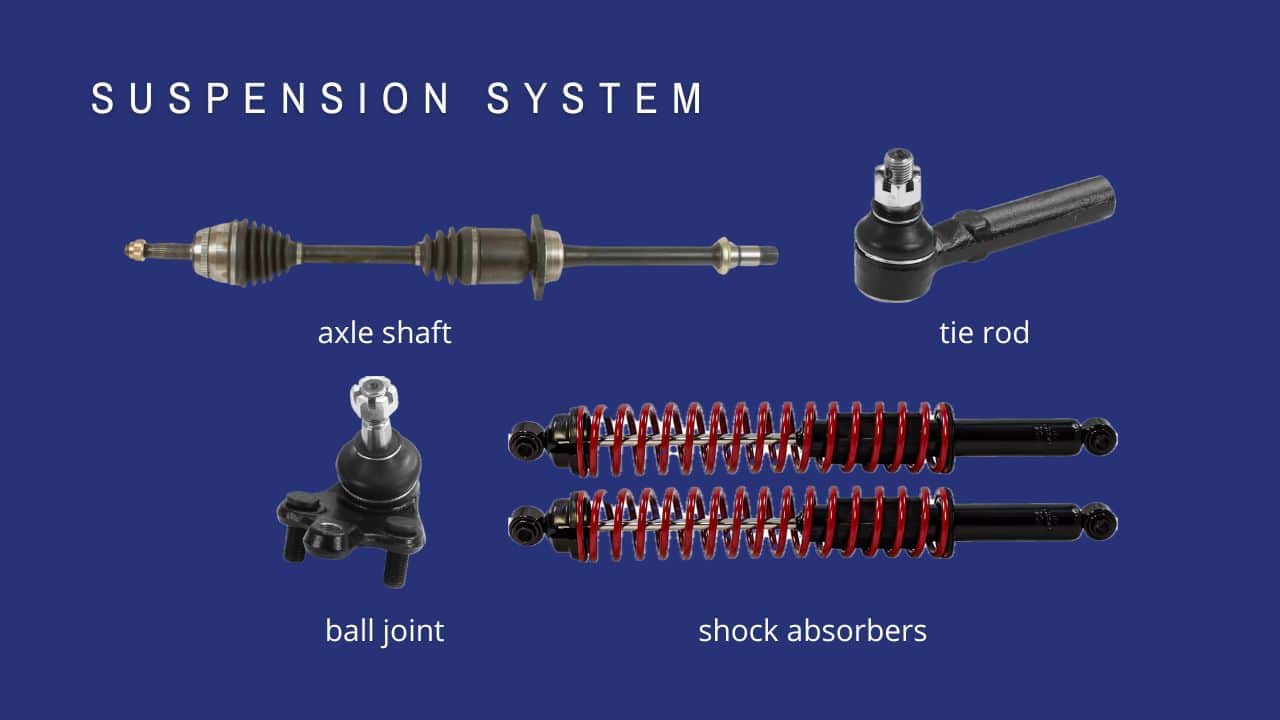
The suspension system smoothens your rides by absorbing bumps, keeping wheels on the road, and preventing damage. Here are some parts that play this vital role and improve your ride.
Axles (Front Axles and Rear Axles)
Every car has axles at the front and rear ends or on the wheels. Generally, these shafts support your vehicle’s weight and transmit power to the wheels.
Tie Rods
These metal rods connect your car’s front wheels to the steering wheel. Aside from moving the wheels when you steer, tie rods absorb road impacts and keep wheels in proper alignment.
Ball Joints
Ball joints are essential for a smooth ride because they allow movement in the suspension. The ball joints resemble a ball and socket and work similarly to hinges, connecting the suspension control arms to the steering knuckles. Thanks to these pivot joints, suspension can move up and down when you drive on rough roads and maintain wheel contact with the ground for a comfortable ride. It also helps the wheel turn left and right when you’re making turns.
Shock Absorbers
As the name suggests, shock absorbers take in shocks resulting from the impact of rough roads, bumps, etc. This prevents vibrations and unwanted movements that could make your rides harsh. Even worse, if your shock absorbers do not work correctly, it could compromise the stability and handling of your vehicle.
Cooling System
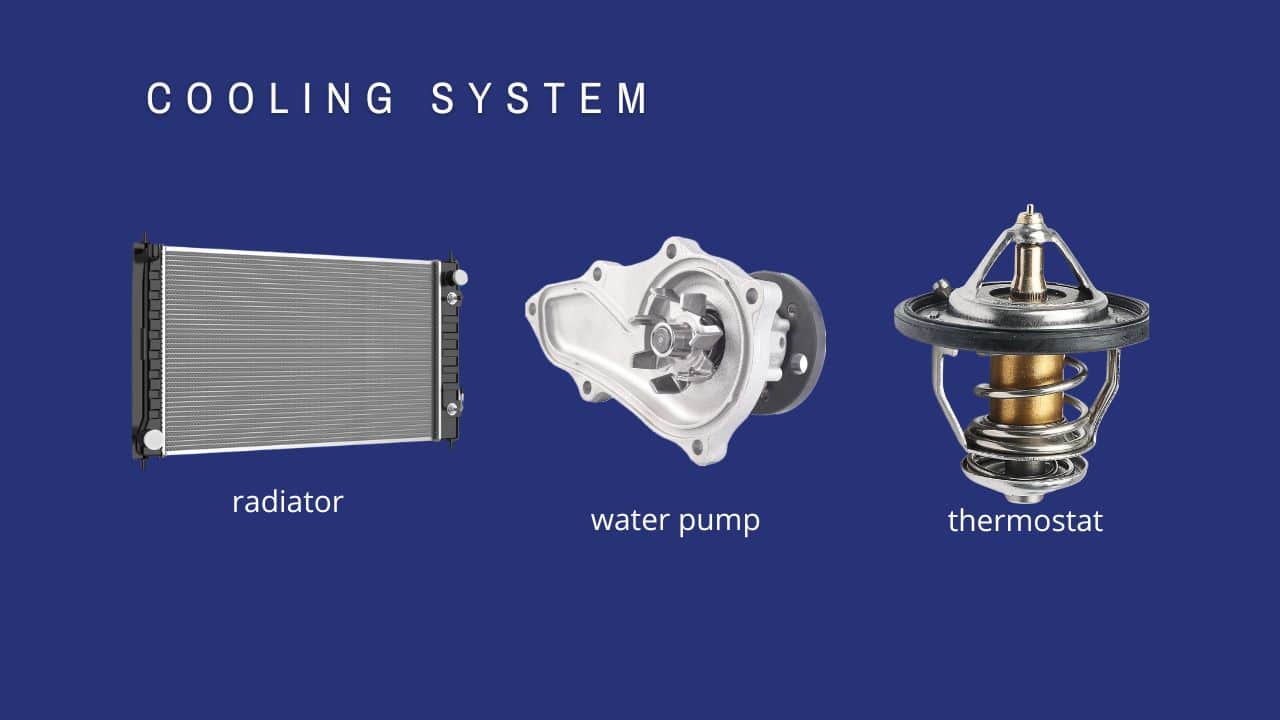
You need to continually cool your engine and keep it at the perfect operating temperature to ensure it works efficiently and prevents wearing out of parts. The cooling system helps to cool your car engine by transferring cooling fluids, absorbing heat, and promoting airflow. Some parts that make up the cooling system include;
Radiator
Worried about overheating? You need to keep your radiator in working condition by regularly flushing and replacing the coolant.
This cooling component keeps your car engine at the right temperature by carrying a coolant. This mixture passes through the engine via hoses, where it absorbs excess heat.
The hot mixture is then returned to the radiator and then cooled by the cool air from the outside. This cycle continues, ensuring it maintains a steady temperature and prevents overheating.
Water Pump
The water pump is regarded as the ‘heart’ of the cooling system. This car component is responsible for moving the coolant between the engine and the radiator.
You’ll notice the water pump has a serpentine belt wrapping that provides power to rotate the impeller blades. These rotating blades create a centrifugal force that sucks in and pushes out the fluid, similar to how your heart sucks in and pushes blood.
Thermostat
A car’s thermostat is at the core of controlling engine temperature. It’s a valve located between the engine and the radiator. When your car engine is too hot, the thermostat valve opens, allowing more coolant to flow to the radiator to cool it. However, when your engine temperature is low, the thermostat valve closes and restricts the flow of coolant, maintaining heat within the engine.
Complete List of Car Parts Names
- A/C Compressor
- Accelerator Pedal
- Air Bag
- Air Conditioning System
- Air Duct
- Air Filter
- Alternator
- Amplifier
- All-wheel Drive
- Automatic Transmission
- Antenna
- Axle
- Axle Shaft
- Battery (Car Battery)
- Battery Cable
- Belt Tensioner
- Ball Joint
- Brake Booster
- Brake Caliper
- Brake Disc
- Brake Light
- Brake Line
- Brake Pads
- Brake Rotors
- Bumper
- Bushing
- Camber Kit
- Camshaft
- Carburetor
- Catalytic Converters
- Center Console
- Chassis
- Child Seat Anchors
- Clutch
- Cooling Fan
- Cooling System
- Crankshaft
- Crankshaft Pulley
- Cylinder Heads
- Dashboard
- Dashboard Cover
- Differential
- Drive Belt
- Drive Shaft
- Drum Brakes
- Engine
- Engine Block
- Engine Mount
- Exhaust Manifold
- Exhaust System
- Exhaust Valves
- Front-wheel drive
- Fuel Filter
- Fuel Gauge
- Fuel Injectors
- Fuel Pump
- Fuel Rail
- Fuel Tank
- Gear Shift
- Gearbox
- Grille
- Grille Guard
- Head Gasket
- Headlight Assembly
- Headlights
- Heater Core
- Hood
- Hydraulic Fluid
- Ignition Coil
- Ignition Switch
- Ignition System
- Intake Manifold
- Internal Combustion Engines
- Idler/Pitman Arms
- Intercooler
- Knock Sensor
- Leaf Spring
- License Plate Holder
- Liftgate
- Master Cylinder
- MAP Sensor
- Muffler
- Oil Filter
- Oil Pan
- Oil Pump
- Parking Brake
- Pistons
- Power Steering Pump
- Propeller Shafts
- Radiator
- Radiator Cap
- Radiator Support
- Rubber
- Rack and Pinion
- Rims
- Serpentine Belt
- Shock Absorber
- Starter Motor
- Steering Column
- Steering Rack
- Steering Wheel
- Struts
- Suspension
- Tailgate
- Throttle Body
- Timing Belt
- Tire Pressure Monitoring System (TPMS)
- Tires
- Transmission
- Turbocharger
- Valve Cover
- Water Pump
- Wheel Bearing
- Wheel Hub
- Windshield Wipers
- Windscreen