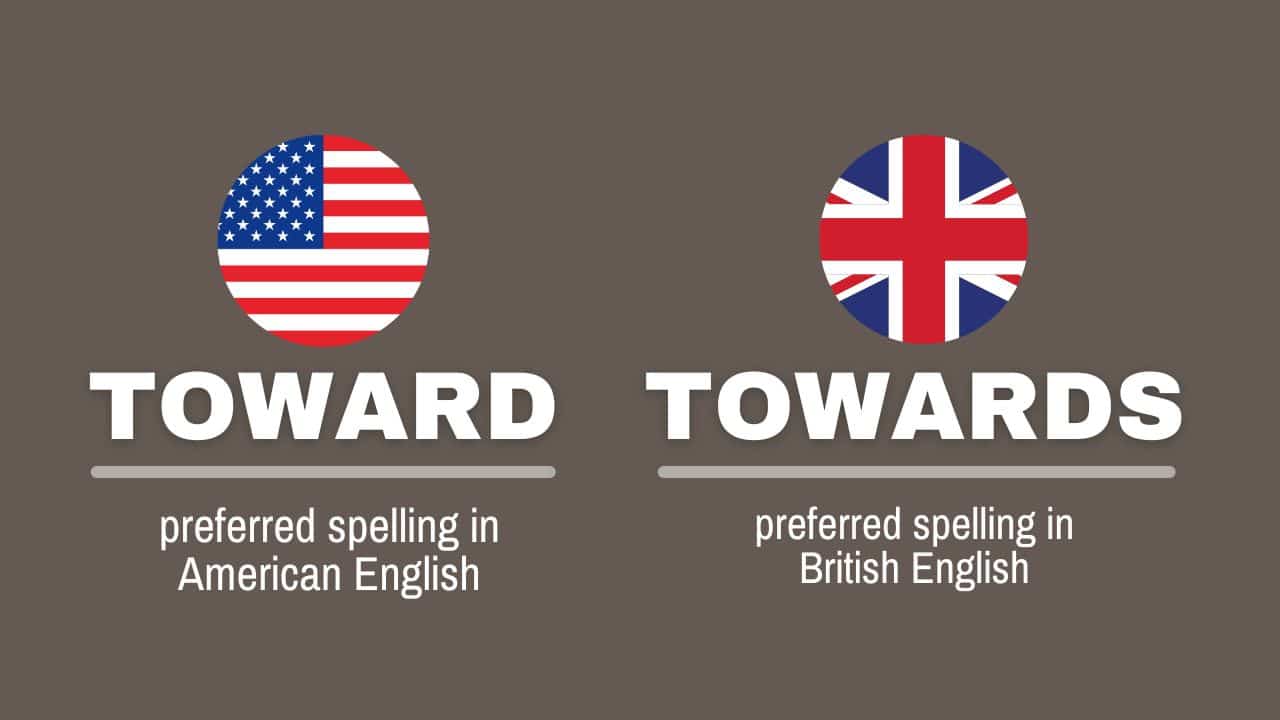
Have you ever been writing a sentence only to get stumped when trying to decide between toward or towards? Believe it or not, both of these spellings are correct. However, toward is the preferred spelling in American English, while towards is the more dominant spelling in British English. If you’d like to learn more about why there are two different but equally valid forms of this word and its correct usage, keep on reading.
Related:
- Ax or Axe: Which Spelling Is Correct?
- Sign Up vs Sign-Up: Which One Is Correct?
- Lier or Liar: What’s the Correct Spelling?
What Is Toward?
Toward is most commonly used as a preposition. In this form, it means “in the direction of.” For example, if you were describing where someone was driving their car, you might say they were going toward the downtown area.
Toward can also be used to communicate an interaction between different nouns. For example, you might say that your friend is loving toward their mother but distant toward strangers.
Toward can also be used as an adjective, but this is less common. In this form, toward usually means “coming soon” or “imminent.”
Fun Fact: Toward evolved from the Old English word “toweard,” which also means “in the direction of” as a preposition and “forthcoming” as an adjective.
Example:
- The man walking toward the front of the classroom turned out to be the professor.
- He acted coldly toward his girlfriend because she forgot his birthday.
- I’m headed toward Walmart. Do you need anything from the store?
- You’re directing your anger toward the wrong person—Sarah’s not the one who stole your backpack.
- Are you driving toward Kansas? If so, could you give me a ride?
- I feel indifferent toward you. I neither love nor hate you.
- John started running toward me, and I knew that something must be wrong.
When and How to Use Toward?
Use toward as you would any other preposition. For example, you might say that an ant is “on” the table. In this example, the preposition “on” tells us how the ant relates to the table.
Toward works the same way. Use this word to link two elements in your sentence and indicate that one is doing something in the direction of the other.
This could mean that something is literally moving closer to something else, such as a car moving toward a garage or a cat moving toward a mouse.
Keep in mind that toward can also mean that someone is directing a certain mood, action, or feeling toward something else. For instance, you might say that your mother feels affectionate toward your father. Similarly, you might say that a public speaker directed his presentation toward his audience.
As mentioned, toward can also be used as an adjective, but this is much less common and rather old-fashioned. Here’s an example sentence using this form of toward:
The toward weather didn't look good for the picnic we planned in the park—every forecast predicted terrible thunderstorms. Tip: Toward is not a slang word and can, therefore, be used safely in formal conversations and writing.
Which One Should You Use?
Now you know what toward means, but how do you choose between using toward or towards?
First things first, why does this word have two different spellings anyway? The answer goes back to the word’s etymology. Remember how we learned that toward comes to us from the Old English word “toweard”? Well, there was also an Old English variation of this word that was spelled “toweards.” This form of the word functioned as an adverb.
Over time, both of these spellings got passed down, and today, we’ve removed the “e” from “toweard” and “toweards.”
Country
Depending on which part of the world you’re in, some people will use toward while others accept the spelling towards. For example, in the United States, people use toward—but in the United Kingdom, there is more preference to towards.
| Countries that use “toward” | Countries that use “towards” |
| United States | United Kingdom |
| Canada | Australia |
Style Guides
You’ve learned which form of this word most people prefer to use in different regions of the world, but what do the official style guides have to say about the subject?
For the AP Stylebook and Chicago Manual of Style, both style guides agree that you should use “toward.”
Final Thoughts
We hope our guide helped you decide between toward or towards. Remember that both of these spellings are correct—but you should use toward if you are writing for an American audience and towards for British audience.