Have you ever heard someone say “touché”? It is a fencing term that acknowledges a hit, but in everyday use, the touché meaning is acknowledging that one person has made a good point.
Let’s take a closer look at this witty retort’s origin, what it means, and how to use it.
Related:
- What Is “On Cloud Nine?” and How to Use It?
- What Does Coup de Grace Mean and How to Use It in a Sentence?
- Je Ne Sais Quoi Meaning: What Does It Mean?
What Does Touché Mean?
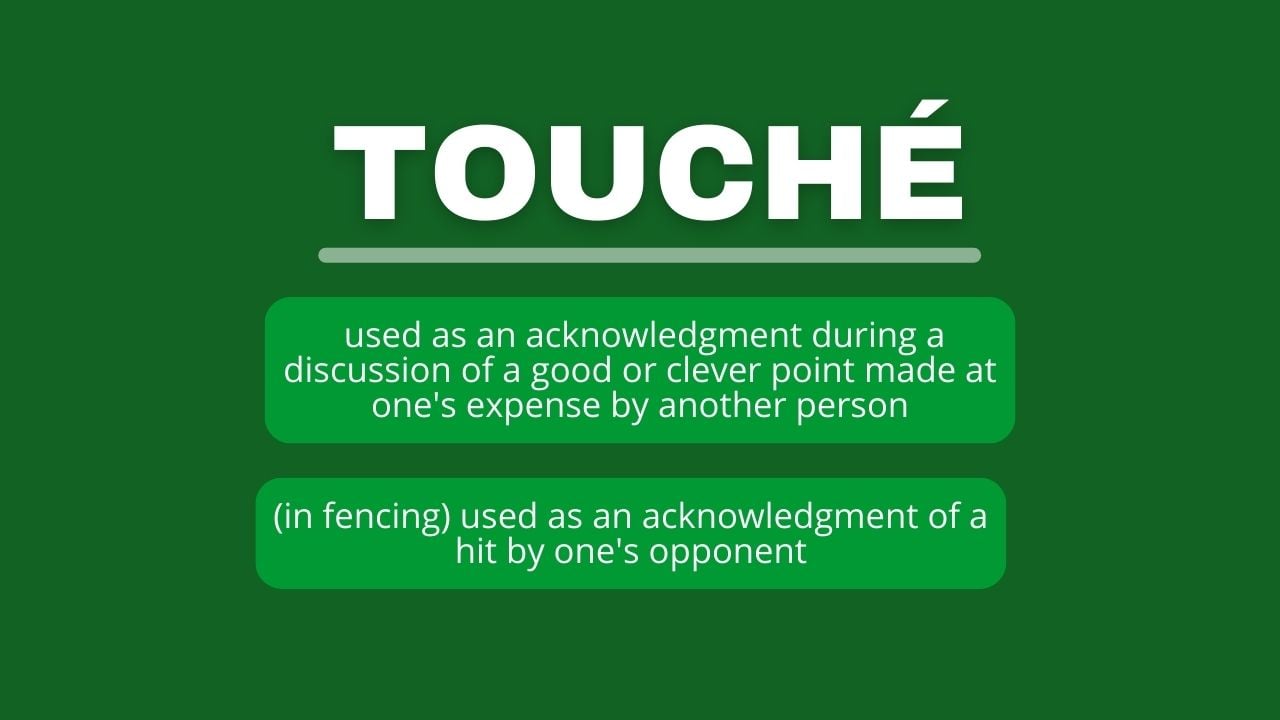
Touché is a French word that admits your opponent has made a strike in a fencing contest. However, in everyday use, touché is an exclamation that your opponent in an argument or debate made a good point or a clever point.
Fun Fact: Touché originated around the early 1900s and came from toucher, French for “to hit.”
People will sometimes say, “Touché, right back at you.” In that instance, you’re still admitting someone else made a good comeback. At the same time, you’re saying you could use the same point against them.
Example sentences
- I admit you found the fatal flaw in my argument. Touché!
- Touché to you for pointing out that I can’t criticize your cookies since I can’t bake!
- Although I disagree with your remedy, I have to say you made a great point. Touché!
- Touché! You win that round, but this debate isn’t over.
- I thought I had you dead to rights, but you totally destroyed my point. Touché!
- Fair point, but it goes both ways, so touché right back at you!
When and How to Use Touché?
Let’s start with how to say touché. This French interjection sounds like “too-shay.” You may see touche and assume “touch,” but the accent mark tells you to use the long a sound.
Technically, touché should have an accent mark, but you’ll often see it without one in English. The lack of an accent mark does not change the meaning or pronunciation of the word.
Scenarios for Using Touché
Touché can stand alone as a response; in fact, it usually does.
Example:
“You thought you had won the debate, but here’s a rebuttal you can’t beat!”
“Touché!”
But it can also be part of a longer response. See below:
- I had you dead to rights, but touché, you made a better argument, and hats off to you.
In the event that someone is using its inverted meaning against you, it might sound like this:
- You’re right, but touche, I can use this same point against you.
How would this last situation play out? Let’s look at an example scenario:
You’re wearing clothes that don’t match in color, and your friend points this out with a laugh. There’s no choice but to admit that your friend is right, but then you notice your friend’s colors don’t match, either. So you say “Touche, right back at you!”
And, of course, the original meaning still applies. If you’re engaged in a bout of fencing and your opponent scores a point, “Touché” is appropriate to say.
Other Ways To Say Touché
Do you want another way to say touché? Following are some alternatives.
- You got me!
- Good one!
- Nice one!
- I stand corrected.
- Well done!
- Props!
- Point goes to you!
Final Thoughts
Touché is a French word that, in the sport of fencing, expresses admission that your opponent has scored a point. The touché meaning, more commonly used today, has to do with argument or debate. It is an acknowledgment that another person has made an effective point or successful point at your expense. In some instances, you can add “right back at you” if the same point applies to the other person.