Which spelling is correct to use, memorize or memorise? Well, both are; the former is the British English spelling, while the latter is the American English one. But which spelling variation should you use? Read on because we’ll discuss everything you need to about the word memorize!
Related:
- Jewellery or Jewelry: Which Spelling Should You Use?
- Accomodation or Accommodation: What’s the Correct Spelling?
- Check or Cheque: Which Spelling Should You Use?
What Does Memorize Mean?

Memorize is a transitive action verb that means to commit something to memory. If you have learned something and know it by heart, you have memorized it.
Related forms of the word include the noun memorization and the adjective memorizable. The word memorize itself comes from the Latin memoria. If you’re thinking that word probably means “memory,” you’re correct.
Sample sentences:
- One of the first things I had to memorize in school was my ABCs.
- There is not enough data for learners to memorize this!
- I think this is a silly way to memorize the dictionary.
- For this project, I’m going to memorize the Gettysburg Address and say it to the whole class.
- You don’t have to memorize the trends.
- We should memorize all the additional terms.
- We don’t need to memorize the thesaurus!
- There should be a breakdown of how to memorize these English terms and Wikipedia snippets.
- In the UK, you need to memorize that it is spelled memorise.
What Does Memorise Mean?
Memorise and memorize mean exactly the same thing: to commit to memory. They also share the Latin word memoria as their origin. The slight spelling difference between the two just indicates British vs. American English.
When and How to Use Memorize/Memorise
Both are regular verbs, meaning that you form their past tenses and past participles by adding -d. For the present participle and gerund forms, you drop the e and add -ing.
Examples:
- She memorized all the vocabulary words. (past)
- The memorized formulas saved me on the test. (past participle)
- We are memorizing the gate code in case we lose the transponder. (present participle)
- Memorizing all the countries in the world is not easy to do. (gerund)
Both words also sound the same: “mem-or-eyes.”
You can use memorize/memorise in both casual and formal conversations.
Something to note is that to memorize and to remember are not exactly the same. Memorizing is actively committing information to memory. On the other hand, remembering is recalling information.
So, when you memorize something, you are going to remember it. However, you can also remember a past event or a snippet of information, for example.
Which Spelling Should You Use?
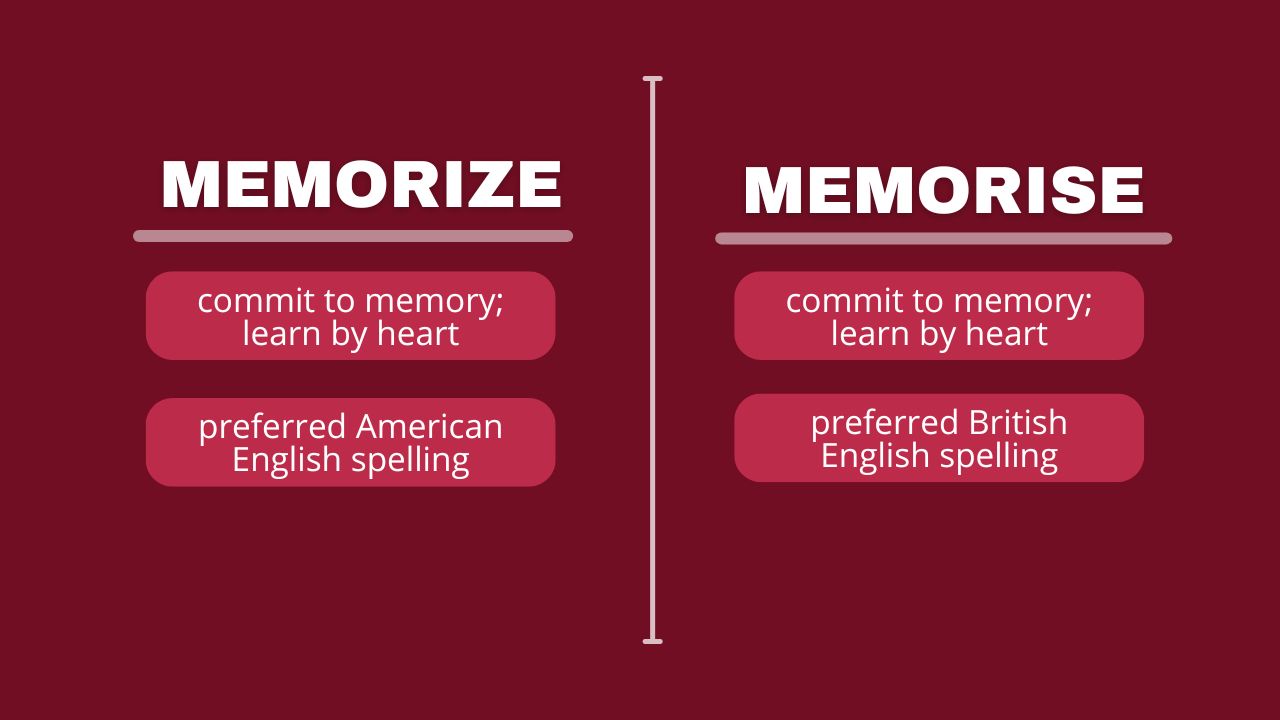
So how do you know when to use memorise or memorize? It depends on whether your audience prefers British or American English.
Countries that prefer British English:
- United Kingdom
- Ireland
- Canada
- Bahamas
- Australia
- New Zealand
- India
- South Africa
Countries that prefer American English:
- United States
- Canada
- Philippines
Yes, Canada is on both lists! That’s because both English versions are common there.
Since the words mean and sound the same, using the “wrong” spelling, fortunately, won’t confuse people. Remember that neither spelling is really “correct”; it’s just that some countries have a preferred spelling.
Final Thoughts
So there you have it! Knowing when to use memorise or memorize requires knowing whether British or American English is preferred. Again, memorise is the British preference, and memorize is the American one.