You’ve probably gotten “off” and “of” mixed up before, but don’t worry, we’re guilty too! We can’t blame you, though – they look pretty similar and the pronunciation is identical, but trust us, they are not interchangeable and have very distinct meanings. If you’re constantly wondering which one to use and each word’s correct usage, you will find the answers here, so read on!
Related:
- What Is a Preposition?
- The No-Nonsense Guide to Grammar Rules (Capitalization, Nouns, Verbs & More!)
- What Are Indefinite Nouns and Indefinite Pronouns?
What Is “Off”

The word off can be used in different ways; it is usually an adverb, but it can also be a preposition or an adjective.
The word evolved from the Old English “of” so it’s completely normal that we get confused. At first, it meant “away” or “away from”. However, in today’s English, it mostly means stopping something, moving away, or getting disconnected.
Here are some examples:
- He turned the lights off before leaving.
- I accidentally walked off the stage.
- Components were ripped off.
- Don’t take your shoes off in the living room.
- Get off the ladder now!
- Take the pen off your jacket.
- The alarm went off at 6 a.m.
When and How to Use “Off” in a Sentence?
Use “off” when something is:
- No longer working or running.
- Being removed or taken away.
- Disconnected.
- Canceled or finished.
Let’s see the proper usage of “off” in a sentence, depending on what you need.
As a Preposition
This is probably the most common use of the word “off.“‘ Use it to show movement or separation from something.
How to use it: Use “off” with a noun or pronoun (the object of the preposition) to indicate what something is moving or separating away from.
Examples:
- He jumped off the bed.
- Get your feet off the table.
As an Adverb
“Off” can function as an adverb to show movement away, stopping, or a change in position.
How to use it: Use “off“ after an action verb to indicate that something stops, departs, or changes state. Since it functions as an adverb, it does not take an object.
Examples:
- The lights went off suddenly.
- She took off without saying goodbye.
As an Adjective
“Off” can work like an adjective too, usually to describe something that’s not working, spoiled, or wrong.
How to use it: Place “off“ after a linking verb (like seems, feels, or smells) to describe a condition or state.
Examples:
- The milk smells off.
- Something feels off about this place.
In Phrasal Verbs
Off is used in many phrasal verbs, where its meaning combines with a verb to create a new expression. These are often idiomatic, so you need to learn them as fixed expressions.
How to use it: Look at the whole phrase, not just the word “off.” The meaning depends on the verb + “off” combination. These are fixed phrases; learn them as a whole.
Examples:
- Take off = to leave or remove
- Turn off = to stop something (like a machine or light)
- Put off = to delay
- Call off = to cancel
Fun fact: The word “off” can be used very informally as a verb and means to kill. As in “They planned to off the witness before the trial.” It is grammatically correct, but not exactly polite.
What Is “Of”

The word “of” connects ideas, adds details, and makes sentences flow. It can also help show that something is part of a larger whole. Unlike off, of is always a preposition.
As we said before, in Old English, the word used to mean “away”, but now it is used as a connector. It shows relationships between things: belonging, parts, origin, description, and more.
Some examples:
- Departure is within this period of time.
- Is there a state of inactivity in the servers?
- It’s a piece of cake!
- I love the color of the sky.
- The color of your shirt is cool.
- The pages of the book have glue.
- He’s a friend of mine.
- The cover of the book was torn.
- Can you make me a cup of coffee?
When and How to Use “Of” in a Sentence?
Use “of” when you need to:
- Tell about possession or connection
- Talk about something being part of something else
- Describe where something is from
- Add description or details
Remember, “of” only works as a preposition. It shows relationships between words, usually things like belonging, parts of a whole, or descriptions.
How to use it: Place “of” between two nouns. It shows a relationship where the first noun is related to, owned by, or part of the second noun.
You can use “of” these ways:
- Belonging or connection.
- The name of the book is weird.
- A friend of my dad came over.
- Parts or amounts:
- Can I have a slice of pizza?
- Half of the people left early.
- Origin or source:
- The people of Japan are amazing.
- Songs of the ’90s still hit hard.
- Descriptions or details:
- Her look of surprise was real.
- A feeling of peace washed over me.
What’s the Difference Between “Off” vs “Of“?
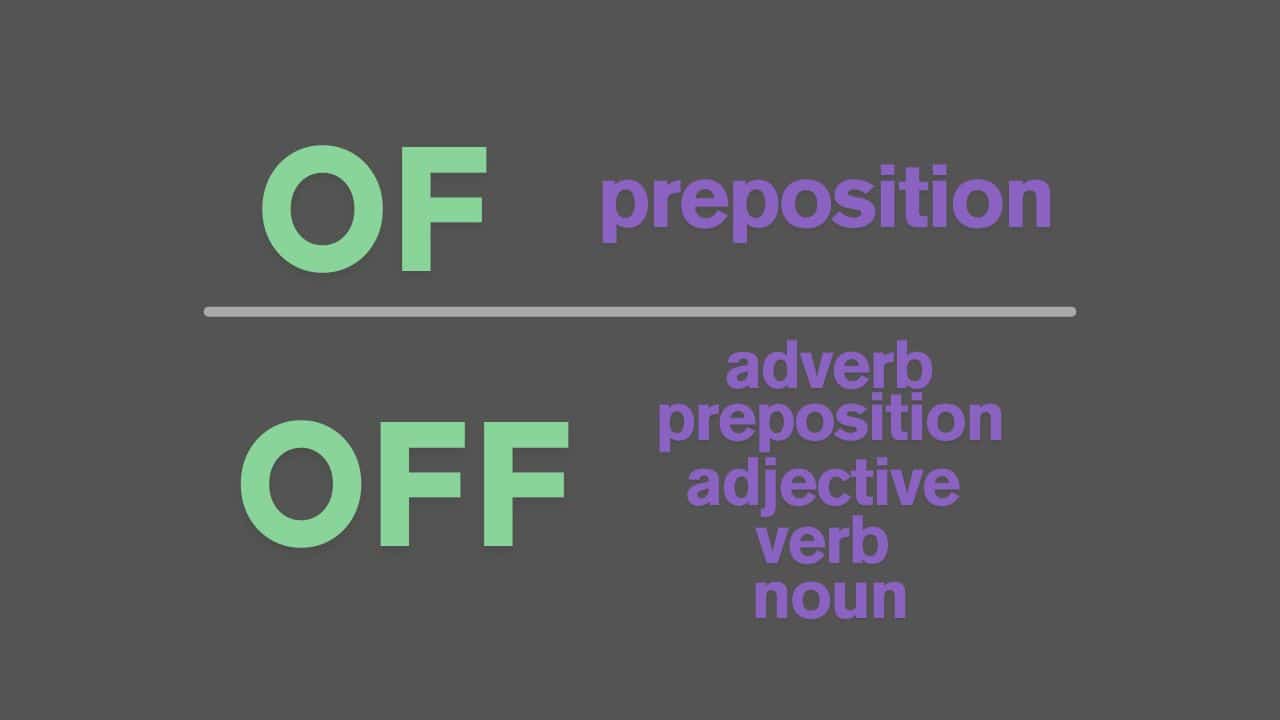
Now we know that even when they seem and sound very similar, off and of are completely different words. Let’s recap:
- “Off” is an adverb or a preposition that indicates movement, separation, or stopping. It can also be an adjective, a verb, and even a noun.
- “Of” is a preposition that refers to connection, belonging, or parts.
Let’s explore the contrast in these two examples:
- He jumped off the chair. Here, the word off is acting as a preposition and indicates movement. It means that he is no longer in the chair.
- The leg of the chair is broken. Here, of is, as always, a preposition, and indicates that the leg belongs to the chair.
How to Remember Which Word to Use in a Sentence
Here’s a quick tip to help you remember the correct choice:
- If something is ending, coming apart, or being removed, you need off.
- If something belongs, relates, or comes from something, you must use of.
Is It Correct to Say “Off Of”
Yes, It is grammatically correct to say “off of.” But most of the time, it is not necessary.
An example would be: He jumped “off of” the table. Its use isn’t technically incorrect, but considering that “off” indicates moving away from something, adding “of” sounds a bit redundant.
Saying “He jumped off the table” is clearer and a better choice.
Final Thoughts
Hopefully, we’ve given you enough clarity to know the difference and correct usage of the words ‘of’ and ‘off.’
Remember, “off” comes mostly from an action. Something’s going away, being turned, or coming undone. On the other hand, “of” is used to connect, to indicate that something belongs to something or someone.