Is it no one, no-one, or noone? Despite how common this phrase is in English writing and conversation, many people are confused about which version is actually the correct spelling. The truth is that the two-word version—” no one”—is the right version. In this article, we’ll explain why “no one” is correct and provide some helpful tips on how to use it, so read on to learn more.
Related:
- Smelled or Smelt: Which Spelling Is Correct?
- Verbage vs Verbiage: What’s the Correct Spelling?
- Apologise vs Apologize: Which Spelling Is Correct?
What Is No One?
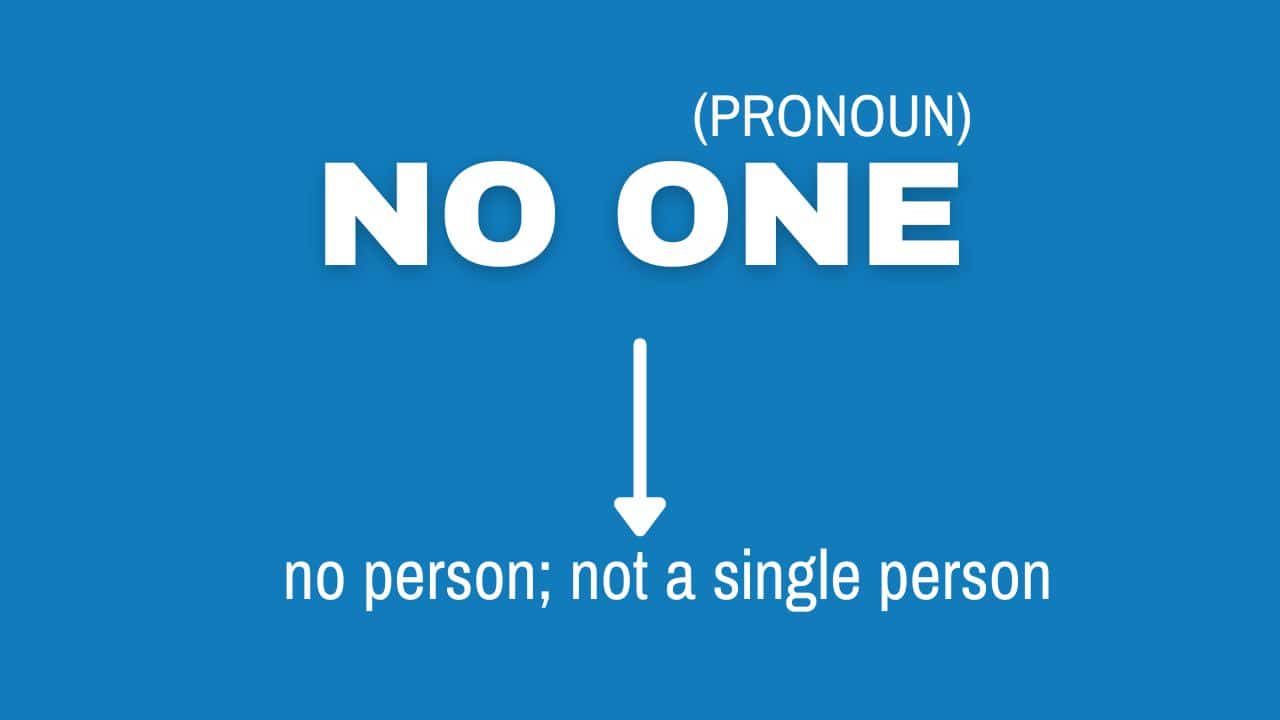
“No one” is an indefinite pronoun (words that we use to replace nouns, such as people, in our writing or speech.)
For instance, instead of saying, “John ate the pie,” you could say, “He ate the pie,” using the “he” pronoun to replace the name “John.”
When you use “no one,” you are still using a pronoun to stand in the place of a noun, but in this case, you are indicating the absence of a person.
So, “no one” indicates that not a single person is or isn’t doing something. For instance, if you knocked on someone’s door but nothing happened, you might say that “no one is home.”
“No one” has been a popular phrase in the English language for quite a while – its etymology goes all the way back to the 1500s!
Examples:
- No one knew why she quit, but she seemed frustrated with her boss.
- The room was totally silent—no one uttered a sound.
- No one can tell me that I didn’t do my very best.
- Sarah asked if anybody wanted pizza for dinner, but no one seemed excited.
- When Sam started his company, no one supported him, but now, he’s a millionaire.
Synonyms of No One
Want to communicate the same idea as “no one” using a different phrase? The following words and phrases are synonyms that mean the same thing as “no one.”
- nobody
- not one person
- not a soul
- not anybody
- not a single person
- zero people
Is No One Followed by Singular or Plural Verb?
Now you know how to say “no one” correctly. But what comes next? When you say “no one,” you should follow it up with a verb to finish up your thought. However, one common mistake people make is following “no one” with a plural verb.
When you use “no one,” you should always follow it up with a singular verb form because “no one” is like a short way of saying “not one person.”
If you said that “not one person likes pineapple on pizza,” you would be using the singular verb “likes.” You would not say, “Not one person like pineapple on pizza” because this would sound awkward and incorrect.
“No one” has the same rule. Always follow it with a singular verb, such as “no one ran for class president,” or “no one clapped after the performance.”
Does No One Have a Hyphen?
“No one” does not need a hyphen to be correct. But would it be wrong if you added one? The answer is a bit complicated.
The hyphenated version is technically correct too, but it is very uncommon and is not used in American English.
Outside of America—such as amongst people who speak British English—you might encounter a very rare occurrence of “no-one” spelled with a hyphen. However, “no one” is more popular and widely accepted no matter where you go, so it’s always best to stick with this version of the word to be safe.
If you’re unfamiliar with hyphens, you should know that these punctuation marks are useful tools for connecting words or parts of words. They are different from normal dashes.
Why Noone Is Incorrect?

Lots of people think that “noone” might be a correct alternative spelling of “no one”, but this is not true. This misconception might come from the fact that “nobody,” a similar word, is written as one word with no spaces. However, when it comes to “no one,” you must always write it as two words.
To help you remember that “noone” is the incorrect spelling, look at the word and ask yourself how someone might read it if they didn’t have any context. They might think you are trying to say the word “noon,” but you accidentally misspelled it.
In short, avoid using no-one or noone and instead use the correct spelling: no one.
Final Thoughts
There’s a lot of confusion with no one, no-one, and no one. Hopefully, our article helped you understand that “no one” is the correct phrase. Again, “no one” is simply an adjective and a pronoun stitched together to form an indefinite pronoun. You can use “no one” to describe situations in which not a single person is doing something.