Wordle has taken the world by storm, and for good reason—it’s simple, challenging, and surprisingly addictive! But as anyone who’s played knows, keeping a winning streak alive can be tricky. Whether you’re aiming to solve puzzles in fewer guesses or just looking to maintain your streak, mastering a few key strategies can make all the difference. In this guide, you’ll learn six essential techniques to help you solve puzzles faster, avoid common mistakes, and make every guess count. Let’s dive in and get your streak going strong!
Strategy 1: Start with Strong Opening Words
Choose words with various vowels and common consonants to maximize your chances of revealing letters early.
Why it works: Opening words with standard letters and at least two vowels cover many possibilities in English words, giving you valuable hints right from the start.
Some of the best starting words are:
- ROAST
- RAISE
- NOTES
- CRANE
- RESIN
- TARES
- TEARS
- CRATE
- SLANT
- LEAST
- SLICE
- TRIED
- CLOSE
- TRACE
- TRAIN
- TRICE
These are great starting words because they are/have:
Vowel-Rich
Each word contains at least two vowels (A, E, I, O, or U), which are essential for uncovering the word’s structure. For example, words like RAISE, NOTES, and SLICE help identify common vowel placements and eliminate several vowels at once.
Common Consonants
These words use frequently occurring consonants, such as R, S, T, N, and L. These are some of the most common letters in English, so starting with them gives you a good chance of revealing correct letters in the answer.
Diverse Letter Distribution
These words include a mix of vowels and consonants without too much repetition, allowing you to test more letters at once. For instance, CRANE and TRACE give you five unique letters, which is ideal for early guesses.
Phonetic Patterns
Words like TEARS and SLANT cover common English phonetic patterns, which is useful because Wordle solutions typically follow standard English structures. Words with common letter combinations (like TR and SL) help narrow down the answer quickly.
Flexible Consonant Positions
Starting words like TRAIN and TRICE often help you determine the potential position of consonants within a word, even if only one is correct initially. For example, if T or R appears but isn’t in the correct spot, it gives a strong hint for rearranging letters in subsequent guesses.
Strategy 2: Think About Letter Patterns
Some letters often appear together, like “TH,” “CH,” “GH,” “ST,” and “SH.” These groupings can occur at the beginning, middle, or end of words.
For example: FIRST, SHUSH, FORTH, WHICH, GHOST
Common endings for five-letter words include -ER, -ED, -ING, and -LY. Keep these in mind when forming guesses.
If you’re stuck, try common vowel-consonant patterns like V-C-V (e.g., APPLE) or C-C-V-C (e.g., BRISK) to help unlock the answer.
Strategy 3: Use Information Efficiently
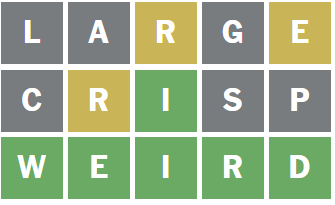
Green letters are in the correct position, while yellow letters are in the word but not in the right position. Use these clues strategically.
After each guess, adapt your word based on both the letters confirmed and eliminated.
Tip: Don’t reuse gray letters in subsequent guesses; it wastes opportunities to find new letters.
Strategy 4: Leverage Process of Elimination
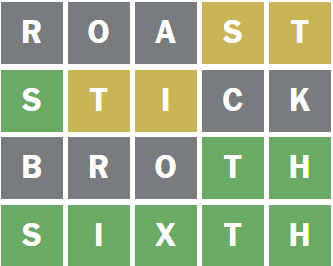
Use guesses specifically to confirm or rule out certain letters, even if it doesn’t look like the “right” answer.
Example: If you suspect letters like “R” or “L” but haven’t tested them, create a word to confirm or discard them in a strategic position. If you are completely lost, you can guess a word with these test letters and none of your known letters.
Strategy 5: Focus on Versatility
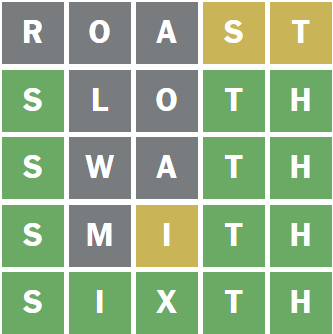
Try to guess words that keep you versatile, meaning they use letters not yet eliminated.
Avoid fixating on one specific answer too early; a flexible approach often reveals surprising solutions.
Strategy 6: Avoid Repeating Common Pitfalls
Don’t get stuck on plurals or overly specific guesses. Wordle words tend to avoid plurals ending in “S” and highly specialized words.
Be mindful of common double letters, like “LL” in SPELL or “SS” in BLISS—they sometimes surprise players.
Also, watch out for words that have two of the same letter. For example, two Es in EASEL.