When writing, using let’s or lets depends upon what you’re trying to say. Let’s is a contraction for let us. On the other hand, lets has several different meanings and contexts, but it generally indicates causing or allowing something to happen.
Related:
What Is Let’s?

As mentioned earlier, let’s is the contracted form of let us. Contractions shorten an expression by substituting an apostrophe for one or more letters.
In the next section, you’ll see that let can mean “allow.” However, let’s is usually not a request to be allowed to do something. Instead, it’s part of an imperative (request or command) for something that’s probably going to happen, anyway.
Example sentences:
- Let’s talk about this before we make a final decision.
- Let’s leave a little earlier in case traffic is bad.
- Let’s hope that this all works out in the end.
- Shannon’s 40th is coming up; let’s plan a nice celebration for her.
- Please, let’s stop pretending that this movie is any good.
What Is Lets?
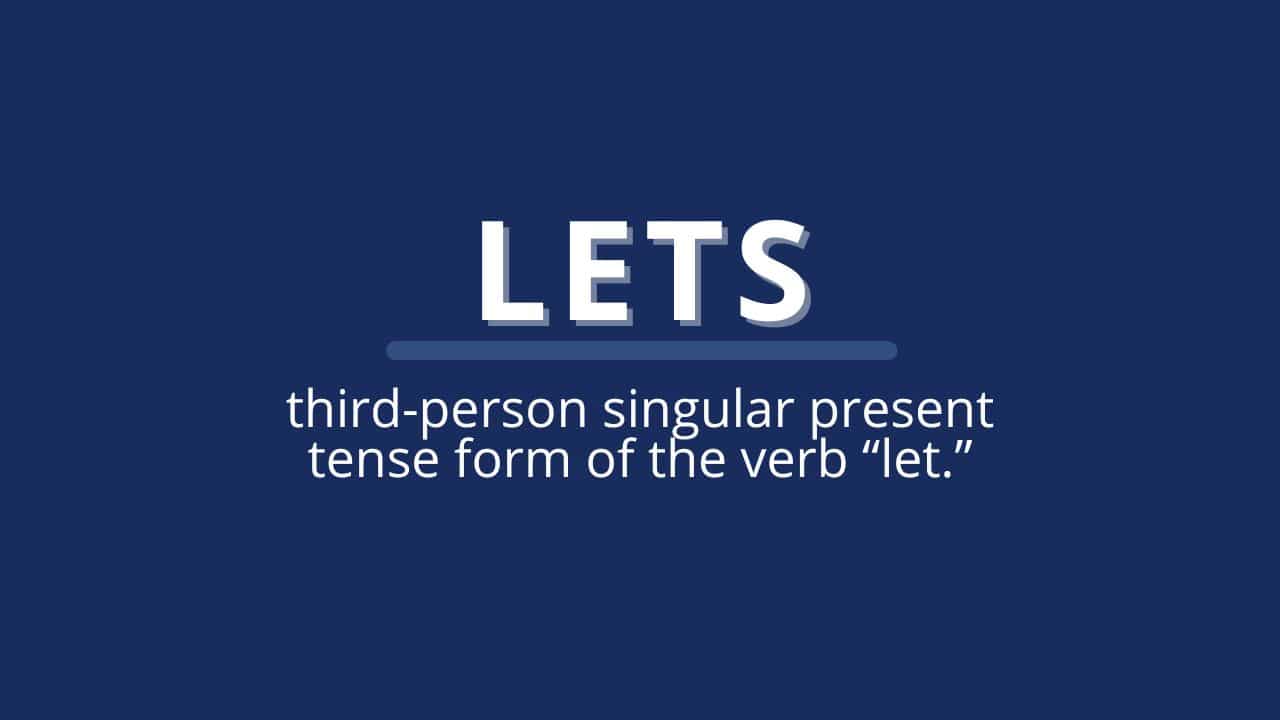
The word lets is an action verb. The ways to use it vary, and we’ll get into them in another section. Right now, it’s helpful to know that the word usually indicates allowing or enabling something. Usually is important since one application mostly applies to British English but sometimes appears in American English as well.
Examples:
- He lets his kids play video games after their homework is done.
- My mom lets me sleep over if she has the phone numbers of my friends’ parents.
- This new development lets us take a fresh approach to the problem.
- The toll booth lets just one vehicle through at a time.
- During peak season, she lets her London flat out to tourists willing to pay top dollar.
What’s the Difference?

For let’s or lets, the main difference is that let’s means “let us” and lets implies allowance, agency, or permission. The former pretty much translates to “Let’s go…” The latter is more often a transitive verb followed by what the subject is letting happen.
See the differences:
- Let’s go to the movies tonight.
- My teacher lets us skip one homework assignment per week if our quiz/test scores stay above 90.
Which One Should You Use?
Choosing which of these words to use depends on the context. Let’s has a very limited application, while lets has a wider range of applications.
When and How to Use Let’s?
Let’s means “let us,” but it usually isn’t asking for permission to do something. Instead, you’re telling people to do something or encouraging them to.
Examples:
- Let’s meet at 9 tonight at our favorite spot and plan things out.
- Let’s just agree to disagree.
You can use let’s in both spoken and written conversations and in almost any medium or situation. However, in some academic and formal settings, using contractions is discouraged or prohibited.
When and How to Use Lets
The verb let has multiple meanings and, thus several different applications.
A common use of the word is for “allow.” You can allow someone to do something or allow something to happen, for example.
Examples:
- The teacher lets us read after finishing a test.
- Your leaving the door open lets flies get inside the house.
The word can also mean “release” or “free.”
Examples:
- My friend lets out a deep sigh when he gets frustrated.
- With a scalpel, she lets fluids from patients’ wounds to help prevent infections.
In the context of clothing, lets has to do with making adjustments.
Example:
- The tailor lets out the pants waist a little if you request it.
In the UK, the word commonly refers to offering property for rent or lease.
Example:
- The owner lets his home out when he’s out of the country.
Note that not all uses of let work with lets. For example, it would be a misspelling to write “Lets pray” instead of “Let us pray.” The correct spelling would be let’s.
Trick to Remember the Correct Spelling
Since these two words sound exactly alike, it can be easy to use the wrong spelling. Fortunately, there’s an easy way to check in many situations.
See if let us instead of let’s makes sense. For instance, take the sentence, “That old window let’s in a draft.”
“That old window let us in a draft” doesn’t make sense, so you know to use lets.
That won’t always work with the “allow” meaning. “She lets us play” and “She let us play” both make sense despite the different tenses. So for that meaning of the verb, make a strong association with the word allow.
Final Thoughts
Deciding to use let’s or lets can be a challenge. However, let’s is always a contraction for let us. Lets is the present tense of the verb let and goes with the third person (he/she/it or a name).