Many people use the words ‘so’ or ‘such’ interchangeably, but there are subtle differences, especially how you should use them in a sentence. ‘So’ is paired with adjectives and adverbs, whereas ‘such’ is partnered with nouns. Not sure which one to use? Here’s how to tell them apart, including their sentence structures.
Related:
- Apart or A Part: Which One Should You Use?
- Should You Use Memorize or Memorise?
- Forteen or Fourteen and When to Spell It Out?
What Is So?
The word ‘so’ can mean different things depending on how you use it.
If you are using it as an adverb, ‘so’ can mean:
- To add emphasis at a great degree. For instance, “He looks so handsome tonight.”
- To a certain amount, but you don’t know exactly how much. For example, “She can only move so fast.”
- To show agreement with something. For example, “He likes cars, and so do I.”
- To confirm or express belief with certainty. For instance, “I believe so.”
As a conjunction, ‘so’ can mean:
- To introduce a statement or question. For instance, “So, where have you been in my life?”
- Show result: For instance, “I was already late for work, so I just took a day off.”
- Show aim or purpose. For example, “I left early so that I could arrive on time.”
Tip: ‘So’ can also act as a substitute word, referring back to a previously mentioned idea or statement. For example, ‘If you think so, then I agree.’
Example sentences:
- “So, what’s the plan for today?”
- “It’s so hot today!”
- “There’s so much food!”
- “It started raining, so we went inside.”
- “She was so happy to see her friend.”
What Is Such?
Just like ‘so,’ ‘such’ can have different meanings:
As a determiner:
- Introduce a noun/noun phrase: For instance, “I have never seen such a beautiful day!”
As an adverb:
- Emphasize a quality (often used with an adjective): For instance, “Joanna is such a good friend.”
Example sentences:
- “I have never heard such music before.”
- “That jerk is such an idiot.”
- “Nobody likes to talk with him because he is such a liar.”
- “They have such a large house.”
What Is the Main Difference Between So and Such?

Although the words ‘so’ and ‘such’ express intensity or degree, they are different in terms of usage. With ‘so,’ it modifies adjectives or adverbs. A simple example is, “She is so happy.”
On the other hand, ‘such’ requires a noun or a noun phrase. You wouldn’t say, “She was ‘such‘ tired that she fell asleep instantly.” Instead, you would rephrase it as “She had ‘such‘ a tiring day that she fell asleep instantly.”
When and How Do You Use Such in a Sentence?
To better understand the correct usage of such in a sentence, let’s take a look at different sentence structures:
Such + Adjective + Noun (Optional: + That)
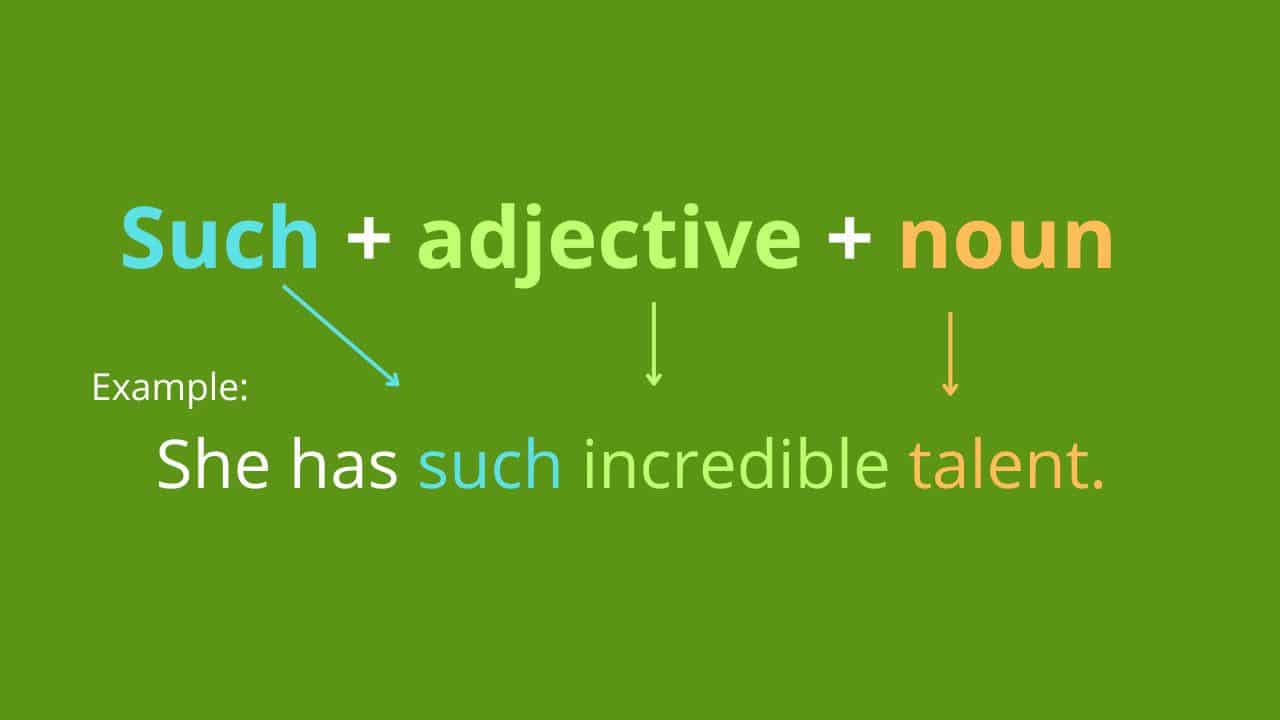
With this structure, you have to place ‘such’ before an adjective and a noun. For example: “Today was such a beautiful day.”
You can also add the word ‘that’ after the noun to add more emphasis. For example, “Today was such a beautiful day that we decided to have a picnic.”
Such + Adjective + Plural Noun / Uncountable Noun

You can also use ‘such’ before plural nouns or uncountable nouns. For example, “We saw such beautiful paintings at the gallery.”
Such + Indefinite Article (A/An) + Adjective + Singular Noun

You can use the word “such” before an indefinite article (a or an), an adjective, and a singular noun. For example, consider the sentence, “It was such an impressive speech that everyone applauded.”
When and How Do You Use So in a Sentence?
Since ‘so’ is more versatile than ‘such’ (remember, it can have different functions in a sentence), here are a couple of ways to use it.
So + Adverb (Optional: + That Clause)

In this structure, ‘so’ comes before an adverb. This usually results in an outcome that can be explained in a “that” clause.
For example, “She ran so quickly that she won the race.” In this sentence, “so” emphasizes how quickly the runner ran, while the “that” clause shows the result.
So + Verb (Informal Usage)

In informal English, you can use ‘so’ to add strong emphasis to a verb. It usually would go in the place of the word ‘really.’
For example, “We so need to finish this project by tomorrow.” Another example would be the sentence, “I so can’t wait for the weekend.” In this sentence, “so” is used to show the eagerness for the weekend.
So + Quantifier (Many / Few) + Plural Noun + (Optional: + That Clause)

Using “so” with words like “many” or “few” before plural nouns intensifies the quantity being described. You could also use a ‘that‘ clause here to provide more details.
For example: “The students have so many books to read this summer.”
So + Quantifier (Much / Little) + Uncountable Noun + (Optional: + That Clause)

You can also have ‘so’ before ‘much’ or ‘little’ and an uncountable noun. Just like other ‘so’ sentence structures above, you can also add a ‘that’ clause.
For example, “I ate so little food at lunch today that I ate my dinner in seconds.”
Final Thoughts
And there you have it! ‘So’ and ‘such’ have similarities —they both help intensify a degree—however, they are different in terms of usage. When deciding between ‘so’ or ‘such,’ remember that ‘such’ always appears before a noun or a noun phrase, whereas ‘so’ modifies an adjective or an adverb.